For years, BESS systems were a nuanced investment; they were a new, promising technology, but expensive to build, and sometimes dangerous to operate. Due to this uncertainty and system complexity, BESS was slow to emerge at scale.
However, in recent years, BESS technology has matured, and the economics of investing in the infrastructure have shifted. Battery costs have plummeted and improvements in lithium iron phosphate battery pack manufacturing have made storage facilities safer, and longer lasting.
Now, installation of BESS systems, once viewed as a premium add-on to an energy asset, are increasingly standard infrastructure – there were 58 GWh of new BESS installed in 2025, 30% YoY growth. This trend is expected to accelerate in coming years. By 2030, analysts project that annual installations of BESS will exceed 110 GWh.
But for solar asset owners, BESS infrastructure introduces a category of risk that the industry is still learning to manage. When BESS is co-located with solar, the natural assumption is that the same O&M teams operating the plant would also cover the batteries. In practice, however, BESS system training and certification for solar technicians is lagging. BESS OEMs in solar-heavy markets are still running specialized trainings to prepare for how to respond to BESS incidents.
While BESS infrastructure comes equipped with an advanced network of sensors, and OEMs publish detailed preventative maintenance guides, in practice, these protocols are not always enough to catch the diverse array of issues that can arise on these systems. In fact, in the past few years, malfunctions on BESS facilities have resulted in material consequences; major BESS fires have collectively caused hundreds of millions in losses, multi-week response efforts, and remediation that stretched more than a year after the event.
Raptor Maps’ new systematic BESS Yard Inspection is designed to help prevent these types of loss events. Read on to learn more about what types of issues our drone inspections are designed to catch, and how teams are structuring robust BESS inspection programs in order to proactively build resilient BESS fleets.
What's Going Wrong -- and Why it Can Go Undetected
The defects that accumulate in BESS yards are predictable, but what makes them dangerous is that they can be hard to find with conventional inspections. Here’s what we’ve seen go wrong:
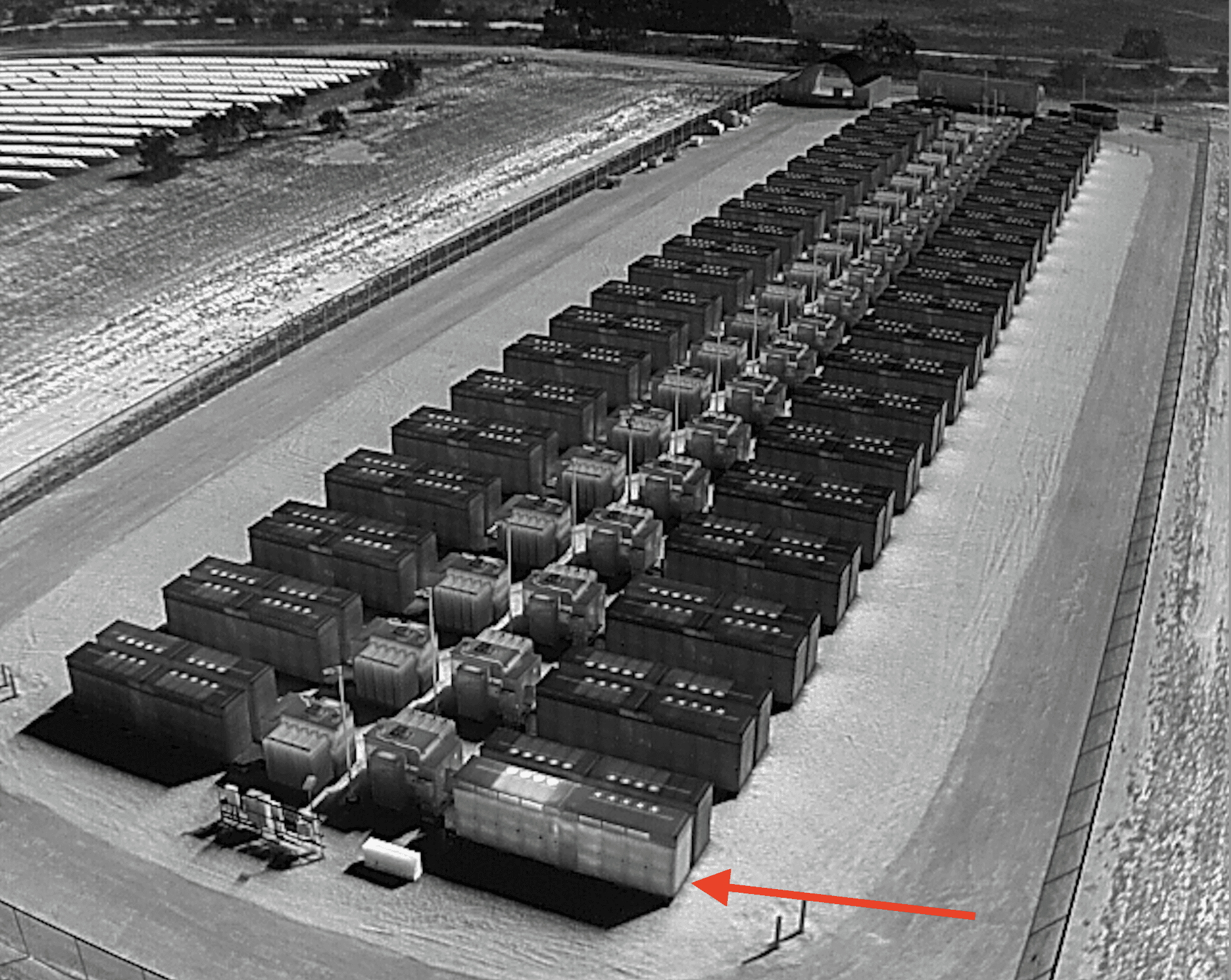
Thermal anomalies. Battery cells generate heat during charge and discharge cycles. When one container or bank section runs meaningfully hotter than its neighbors, it can indicate battery cell degradation, load imbalance, or indicate an alternative early-stage failure. Sensors in the BESS equipment will often flag significant deviations in heat, but they tell you a problem exists — not where exactly it's occurring or how it compares spatially across the rest of the yard. And these signatures are only pronounced during active charge or discharge. During standby, temperature differentials flatten out, making developing issues harder to detect if inspection cycles are not aligned with charge-discharge periods.
Wiring and cable tray defects. Deviations from the nominal wiring layout, including unsecured runs, signs of overheating, and damaged conduits, are leading indicators of electrical risk in BESS infrastructure. Water ingress through cracked or compromised cable trays creates conditions for faults that, left unresolved, can escalate into electrical arcing that can cause fires.
Oxidation and enclosure failure. Corrosion on bolts, cabinet surfaces, and structural components is often the first indicator that enclosure seals have failed. Once moisture enters high-voltage enclosures, the risk profile changes materially, as noted above.
Civil and environmental degradation. Erosion along pad edges, drainage failure, vegetation intrusion, and oil leaks from transformer fins are the kinds of anomalies that accumulate between inspection cycles when no one is systematically looking. While none of these defects may individually constitute an emergency, collectively, they represent compounding exposure to equipment damage, environmental liability, and reduced asset longevity.
The common thread: ground-level PM walkthroughs aren't guaranteed to systematically catch these issues. Thermal signatures require the right sensor and precise timing. Erosion at the far end of a large pad may go unwalked for months. Wiring anomalies inside and around containers require close, consistent visual coverage that manual inspection rarely provides. This is why we are seeing more of our customers turn to drone-based inspections for their BESS infrastructure, which, as we will see in the next section, are designed to catch budding risks before they turn into significant loss events.
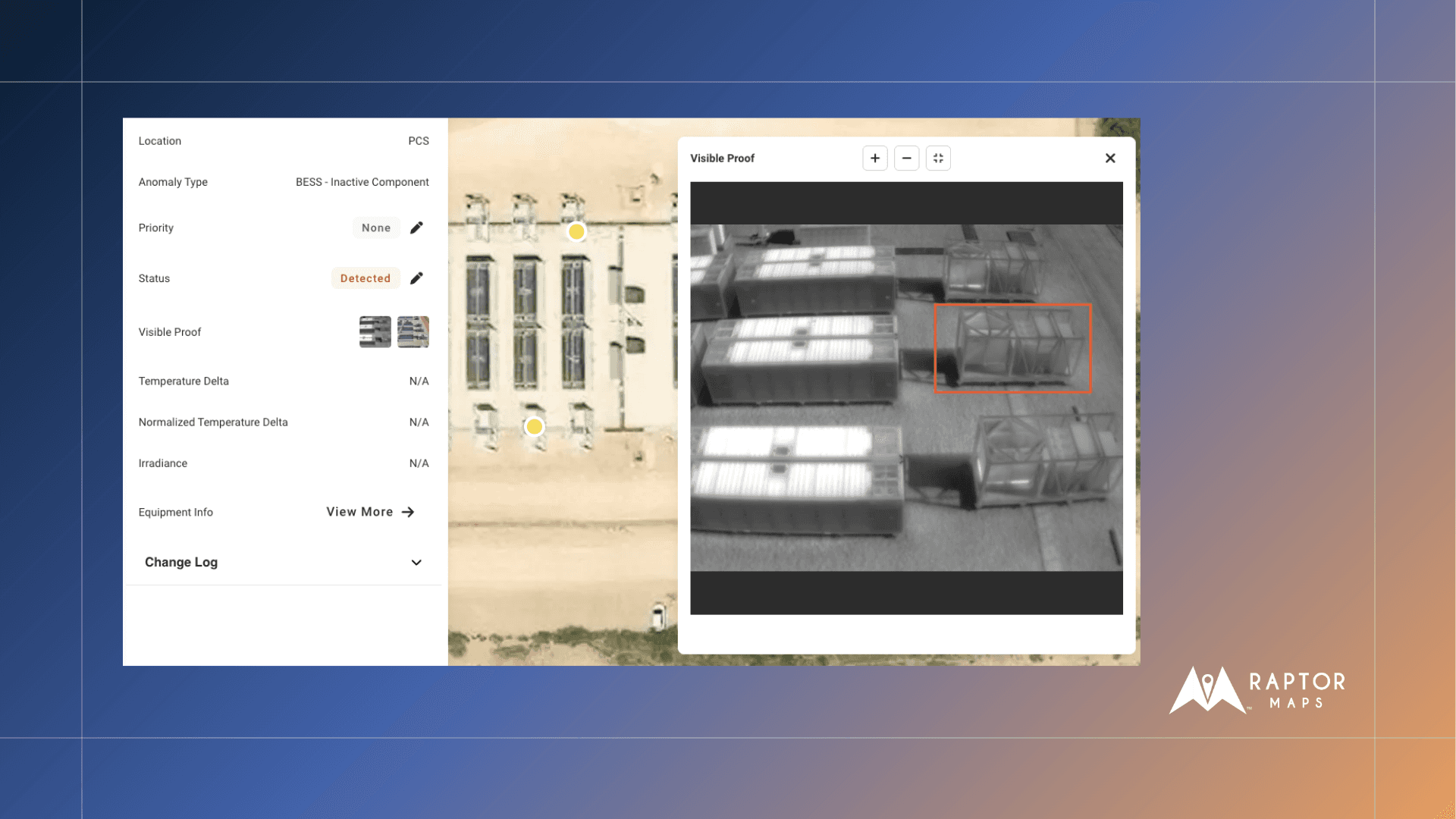
Thermal anomalies on BESS equipment spotted by Sentry, Raptor Maps' autonomous drone solution
What Systematic BESS Inspection Looks Like
Raptor Maps’s BESS yard inspection uses aerial RGB and thermal (IR) imagery captured during active charge or discharge windows, when battery thermal signatures are most pronounced. Flights cover multiple aerial angles designed to augment what can be seen from on-the-ground walk-throughs.
The analysis produces a structured set of tagged findings across the full BESS defect taxonomy: thermal signatures, physical component defects, and environmental condition degradation. Every finding is georeferenced, linked to imagery, and delivered in the Raptor Maps platform in a digital twin.
In practice, the inspection has already surfaced issues that would have been difficult or impossible to catch through conventional means. On one site, we identified corrosion on top of a BESS enclosure — not somewhere a technician would typically be looking — that supported a successful warranty claim with the OEM.
On another, the thermal signature on the exhaust fans was hotter than its neighbors, likely due to an internal valve failure; the site's SCADA system sent an alert on the same unit a couple of hours later, confirming the finding and illustrating exactly the detection gap that aerial thermal inspection can close.
We have also identified damaged cable trays that, left unaddressed, create the conditions for water ingress and the electrical faults that follow.
For asset owners, gathering this data at a scheduled cadence translates to a regular, auditable record of BESS yard health that makes deterioration visible before it becomes a loss event. The output of these inspections is a structured, defensible report with consistent data that can support O&M prioritization, lender reporting, or insurance conversations.
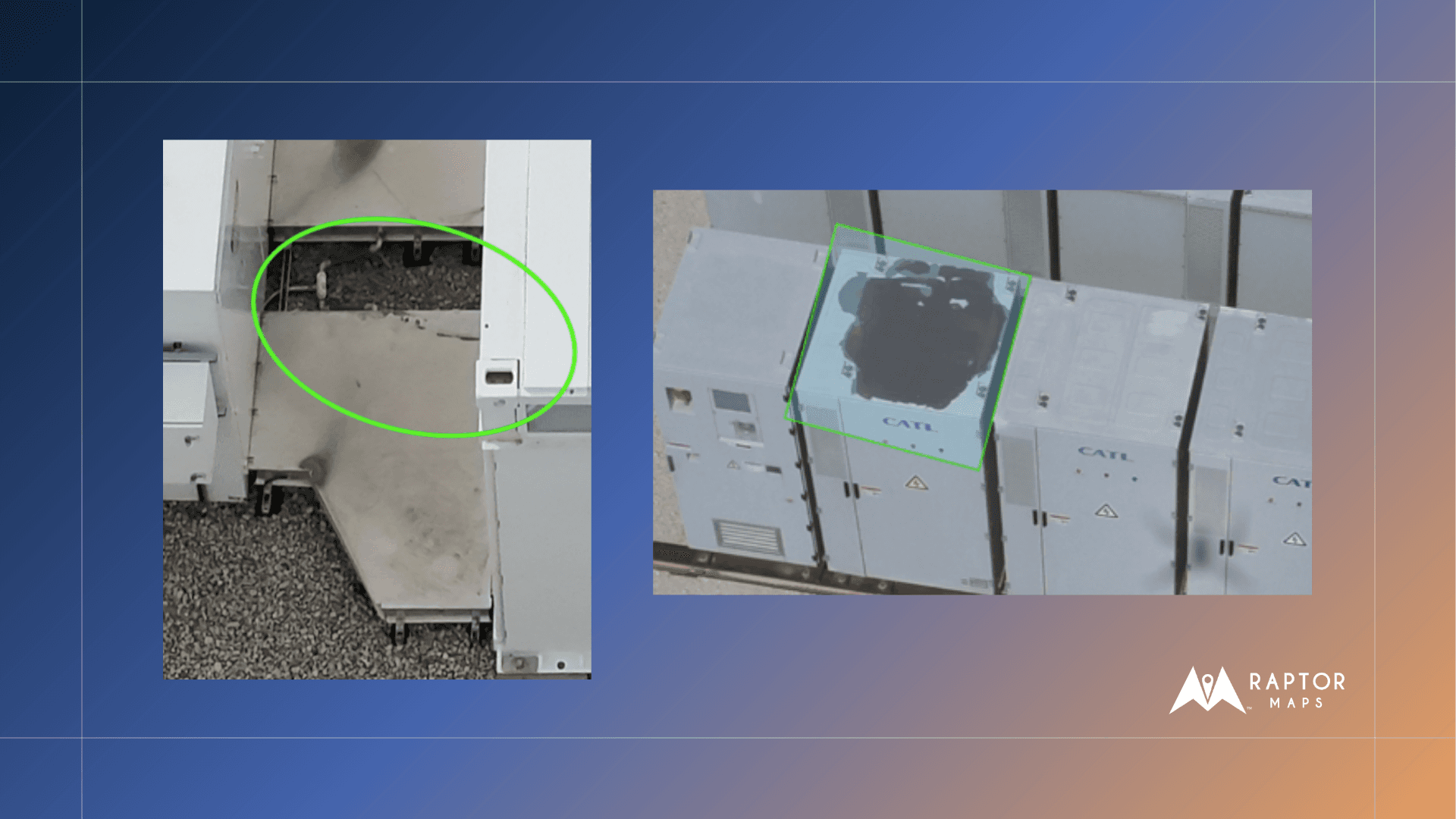
Left: Loose wiring in the cable tray. Right: Corrosion on top of a BESS unit. Both defects were spotted with a drone
Drones-as-First-Responders
Beyond pre-scheduled inspections at a regular cadence, autonomous drone systems, like Raptor Maps’ Sentry solution, give asset teams instant visibility into BESS yards during, or directly after weather or electrical events. Because Sentry drone units are permanently deployed on-site and controlled from our Remote Operations Center, there's no pilot needed to mobilize during emergency events, and insight latency is dramatically reduced. Instead, a mission can be launched within minutes to assess damage, or live-streamed during an active emergency to give stakeholders real-time aerial and thermal intelligence no matter where they are.
The ability to deploy drones-as-first-responders is also a best practice for site-team safety. Instead of deploying humans to gather data from potentially unsafe conditions in a BESS yard, drones can gather that information.
The New Operating Standard
The economics of solar and storage have shifted, and the operating model is shifting with them. For most of the industry's history, frequent inspection of critical infrastructure was a constraint problem — limited by pilots, mobilization windows, and the cost of getting eyes on equipment between scheduled PM cycles. Autonomous drone systems like Sentry remove that constraint. High-frequency, high-resolution visibility into BESS yards, substations, and balance-of-system equipment is no longer an aspirational thought; it's a deployable program.
Our 2026 Global Solar Report shows what that shift is already worth: the average solar asset lost $5,070 per MW in annualized revenue in 2025, and underperformance has more than doubled over the past five years. The assets pulling away from that average are the ones with the most visibility into their own health — sites running autonomous drone-based inspection programs averaged 3% power loss versus 5.08% across the dataset.
The leading asset owners are reading the same data we are. They're treating frequent, structured inspection of BESS and other critical infrastructure as table stakes, not a premium add-on. Leaving these systems outside a structured inspection program is still a risk decision — it's just an increasingly difficult one to defend.
Next steps
From the civil engineering on your site down to the wiring on the back of your panels, the Raptor Solar platform provides you detailed, up-to-date data on the conditions and performance of your solar fleet so that your team has the intel they need to do their jobs effectively, quickly, and safely.