We recently sat down with Michael Perron, Renewable Energy Market Lead at FM, on the Raptor Report Podcast. Having spent 20 years as a broker before joining FM, Michael now leads FM’s renewable energy efforts. With over 2,000 engineers employed across its 6,000 person workforce, FM is one of the most technical, engineering-driven insurers operating in the solar industry, which is why we were excited to host him on the Raptor Report Podcast.
Our conversation covered a range of timely topics for asset owners, including building evidence for cheaper insurance terms, hail-stow verification best practices, reducing fire-risk, and a more general discussion around building reliable assets through designing robust risk management programs. Here are three takeaways that stood out from our conversation.
1. Building Robust Risk Datasets is Becoming Tablestakes for Insurance Renewals
Throughout our conversation, Michael mentioned that renewal conversations with insurers are increasingly going to be a data conversation. Owners who can produce third-party-verified stow testing, predictive maintenance records, hail sensor data, and equipment-level inspection histories will have meaningfully different underwriting conversations than owners who don't. Some of that will translate to premium. Some will translate to whether a project gets renewed at all in five years — because, as Michael pointed out, "insurance policies renew every year. So if we have a project that we think is a good project this year and next year, well, a couple of years from now, if we think it's not so good a project, we can walk away."
2. Reliability Requires Investment
At one point in our conversation, Michael said: "Resilience is expensive, except in retrospect." The point being that the cost of building a project to actually withstand its environment can look like overspending — right up until a storm hits, at which point it looks like a smart choice.
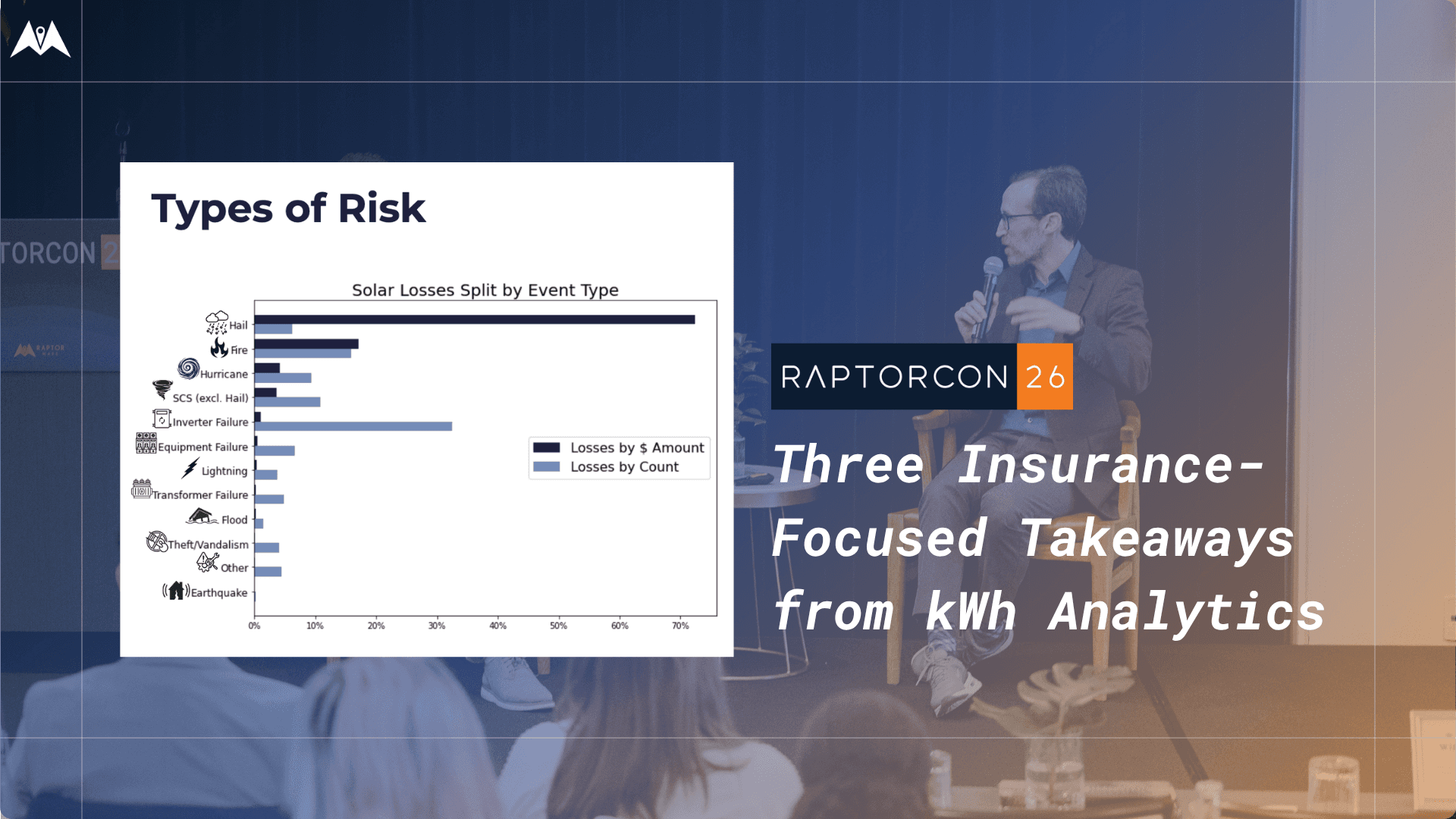
The hail story in solar is a clean illustration. The industry took designs originally engineered for California and the East Coast and deployed them, mostly unchanged, into hail-prone zones across Texas and the central US. Then those projects got hit with severe hail events that they were not prepared for. The 2019 hail event that produced a $75 million loss caught insurers off guard. Three more events in Texas in 2022, each in the $30–50 million range, drove home that these storms weren't one-off anomalies.
The instinctive industry response — high-angle stow and auto-stow systems — is the right direction, but Michael believed that these systems can yield a false sense of security. Recent research from Groundwork Renewables, Michael's own team at FM, and VDE has now independently confirmed that 75-degree stow performs better than lower angles, but not as well as models alone had suggested.
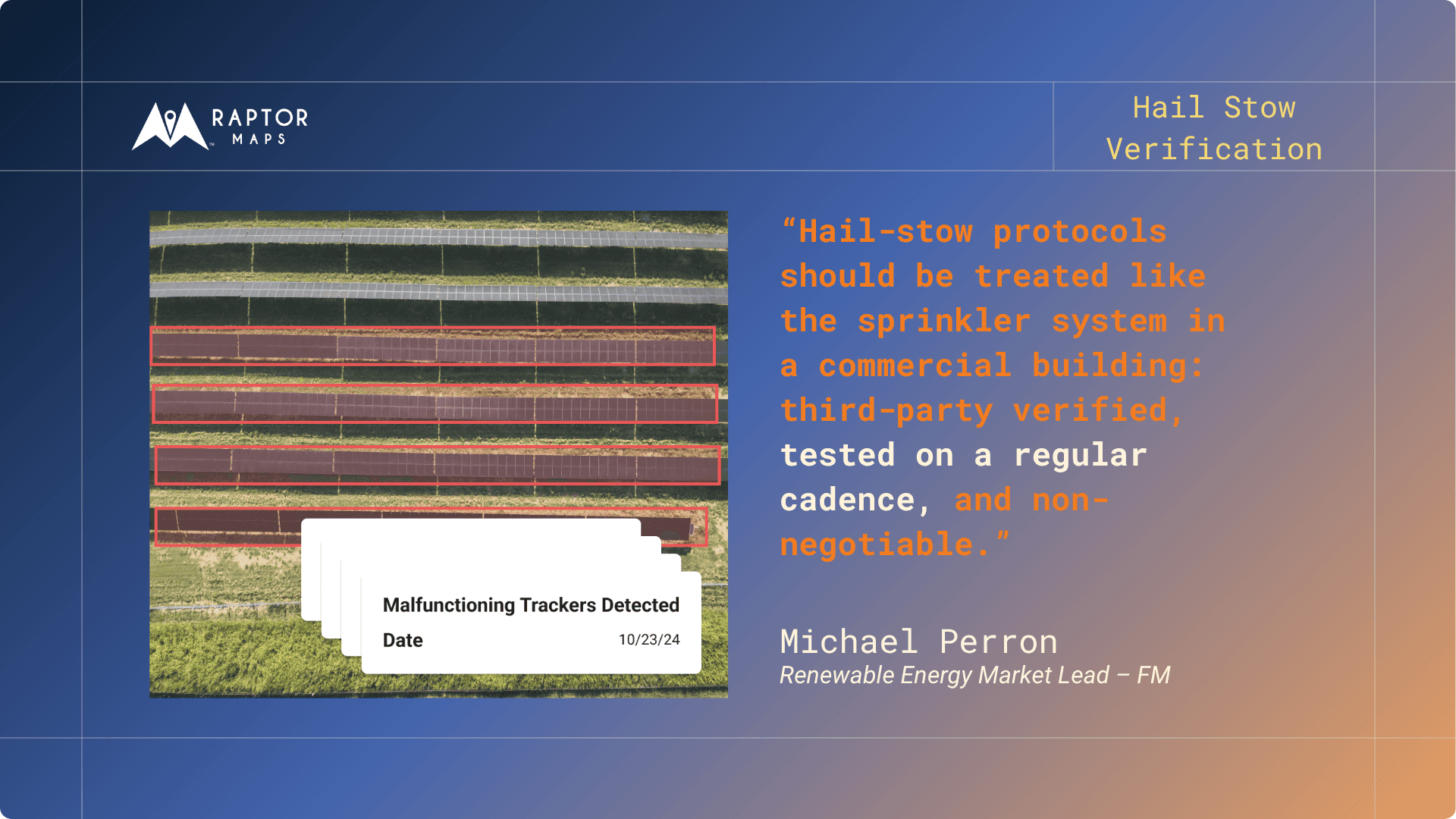
Of course, verifying that tracker systems are reliably stowing to this angle consistently is another story. Michael's analogy was that stow protocols should be treated like the sprinkler system in a commercial building: third-party verified, tested on a regular cadence, and non-negotiable. Today, most operators verify stow at commissioning and then occasionally spot-check thereafter. That's the gap. If he could wave a wand and add one universally collected dataset to the industry, it would be third-party-verified end-to-end hail stow testing, both pre-COD and monthly. "A simple video-verified test could prevent nine-figure losses," he said.
3. The Risks Insurers Worry About Extend Well Beyond Hail
Hail leads the conversation because hail leads the loss data, especially for nine-figure events. But Michael was clear that there are other risk categories that accumulate more quietly that insurers are also focused on. Three risks came up repeatedly:
Transformers. The cycling nature of solar generation stresses transformers more than the industry initially expected, and we're seeing an uptick in failures as fleets age. Compounding the problem, supply chain constraints have stretched transformer replacement lead times from a few months to, in some cases, a few years. A single transformer failure that used to be a months-long event is now potentially a multi-year outage.
Inverter and vegetation-driven fires. Inverters fail in predictable ways — fans stop working, filters clog, and units that run too hot for too long eventually break down and can ignite. Vegetation fires, on the other hand, are often caused by wiring defects behind panels that produce electrical arcs, which can ignite the dry grass, leaves, and debris that accumulates underneath an array. Both risk categories compound when preventative maintenance is deferred, and mitigating both requires robust inspection and documentation procedures.
The cost of building cheap. One thing that insurers have observed over time is that the solar industry sometimes optimizes for upfront construction cost over long-term asset performance. The delta can look meaningful in a financial model at the time of investment. A decade into operations, it may not. The symptoms show up in equipment that degrades faster than projected, maintenance burdens that weren't budgeted for, and performance gaps that compound quietly year over year.
Michael pointed to module resilience as an illustrative example of how he thinks about constructing reliable solar farms in an integrated way. Glass strength, framing, and thickness are all key drivers of loss outcomes that need to be given due consideration depending on a solar farm’s location, and some combinations will be more expensive than others.
What This Means for How We're Building Solar Assets
The most mature asset owners are thinking about building business cases for better insurance renewals through data. Michael mentioned that his team learns a lot when things go wrong, but they also learn a lot when things don't go wrong. As Michael put it, "We always hear about when things don't work, but we also want to know about when it does work so we can learn from the near misses."
That reframes how asset owners can think about the data they're collecting on their sites. Inspections and monitoring exist to catch problems before they become losses, but they also generate something insurers increasingly want to see at renewal: evidence of risk mitigation. Evidence that stow protocols are being tested, not just installed. Evidence that transformer health is being monitored continuously. Evidence that the small things, like connector temperatures, module hotspots, and tracker behavior, are being watched.
Michael's framing of insurance as an engineering discipline that happens to include underwriting is a useful one. The best outcomes for asset owners come from designing, operating, and documenting their sites in detail, with an engineer’s eye. The owners doing that work now might spend the next decade on a different cost curve than the ones still treating insurance as a line item to optimize at the last minute.
If you’d like to learn more about how Raptor Maps is building solutions for risk management and mitigation, we’d love to hear from you. Get in touch with our team here, and we’ll reach out.
The full conversation with Michael Perron is available on the Raptor Report podcast, wherever you listen or on our website here.
Next steps
From the civil engineering on your site down to the wiring on the back of your panels, the Raptor Solar platform provides you detailed, up-to-date data on the conditions and performance of your solar fleet so that your team has the intel they need to do their jobs effectively, quickly, and safely.